Skip to content
United Kingdom

The British Gold Sovereign

United Kingdom · depuis 1817 · Gold

Written by the Maison Or & Bijoux Cannes team · updated

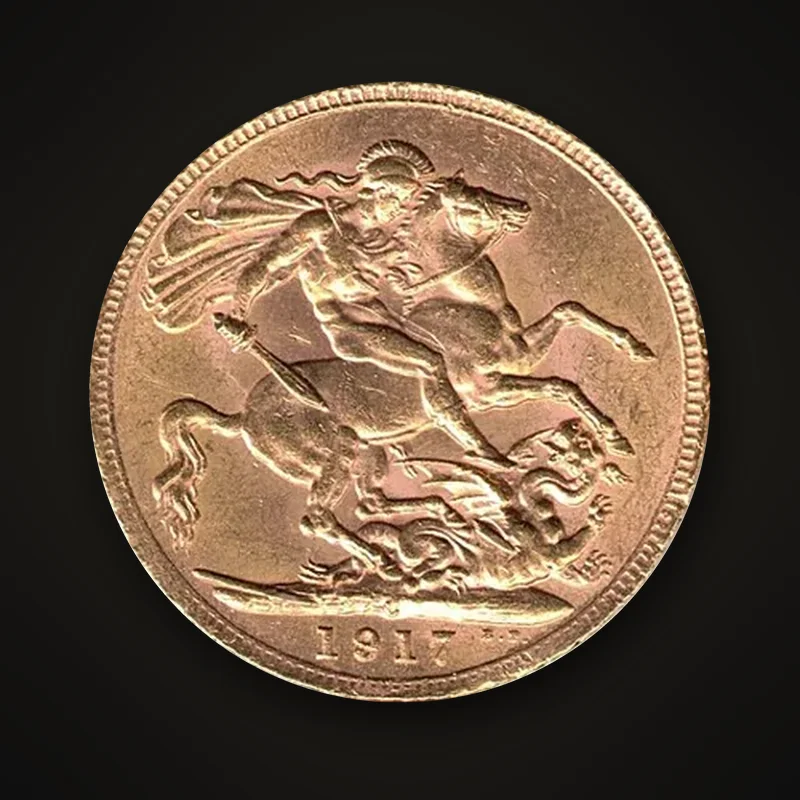
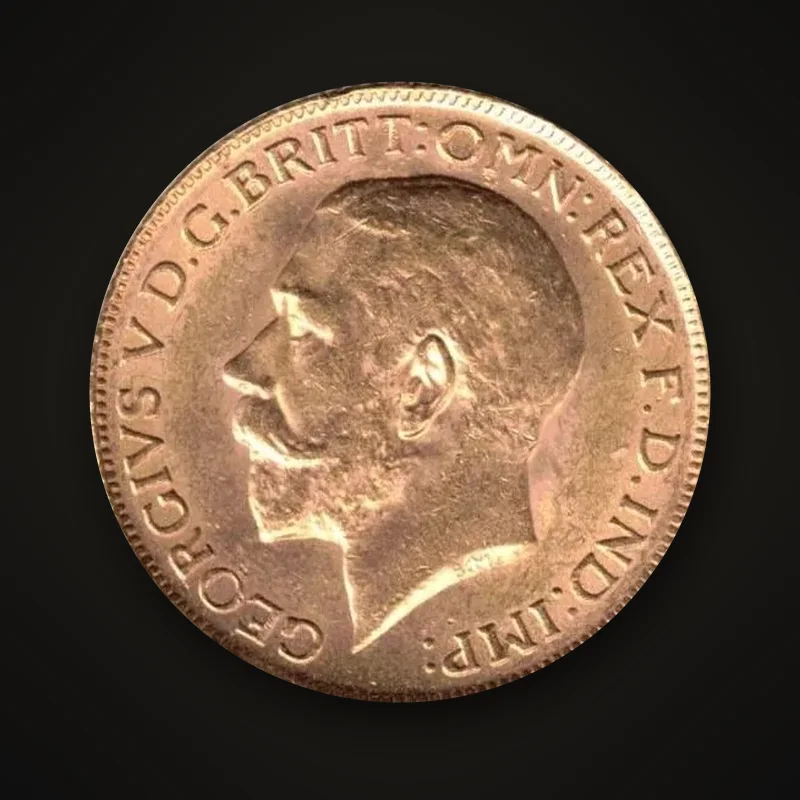
Gold sovereign of George V, obverseSovereign, reverse with Saint George slaying the dragon
Photos: Snd3054, CC0, via Wikimedia Commons, cut out on a black background.
Specifications
CountryUnited Kingdom
Metal22 carat gold (916.7‰)
Weight7.988 g; half sovereign 3.99 g
Fine gold7.322 g; half sovereign 3.66 g
Diameter22.05 mm; half sovereign 19.30 mm
Years struck1817 to date, with breaks (no circulation coins between 1933 and 1956)
MintsLondon (no letter), Sydney (S), Melbourne (M), Perth (P), Ottawa (C), Bombay (I), Pretoria (SA)

The sovereign is the one-pound gold coin struck by the Royal Mint since 1817, and also in Australia, Canada, India and South Africa. The king's or queen's portrait tells you the period; the tiny letter near the date tells you the mint. Because it travelled to every continent where the British Empire traded, it now turns up in families of every nationality.

Identification

The British Gold Sovereign: how to recognise it

Gold sovereign of George V, obverse

Obverse

Effigy of the reigning monarch, facing right or left depending on the reign, surrounded by an abbreviated Latin title. Under George V, for instance: “GEORGIVS V D.G.BRITT:OMN:REX F.D.IND:IMP:”. On Victoria's early sovereigns the legend is simply “VICTORIA DEI GRATIA”.

Sovereign, reverse with Saint George slaying the dragon

Reverse

Either Saint George on horseback fighting the dragon, designed by Benedetto Pistrucci and signed “B.P.” beside the date, or a crowned shield of the royal arms, framed by laurel under Victoria, with “BRITANNIARUM REGINA FID: DEF:”. Saint George covers 1817-1825 and every year since 1871; the shield fills the period in between.

Edge
Reeded (milled) on coins made for payment; a few recent collector issues have a plain edge.
Engraver
Pistrucci for the horseman; Jean-Baptiste Merlen for the 1825 shield. Effigies: William Wyon (William IV after Chantrey, then young Victoria), Joseph Edgar Boehm (1887), Thomas Brock (1893), George William de Saulles (Edward VII), Bertram Mackennal (George V), then Mary Gillick, Arnold Machin, Raphael Maklouf, Ian Rank-Broadley and Jody Clark for Elizabeth II, Martin Jennings for Charles III.
Dates and mintages

The British Gold Sovereign: key dates

The table pairs a date with a mint, so the first step is finding the letter. On the Saint George reverse it sits on the small patch of ground between the hooves and the date; on the shield reverse it is tucked below the laurel wreath; on the first Australian Saint George coins, look for it below the bust, on the portrait side. No letter means London. The 1920s dates from Sydney and Melbourne deserve the closest look.

The British Gold Sovereign: dates and mintages
YearMintMintageRemarks
1817LondonunknownVery first year, Pistrucci's horseman.
1819London3,574Tiny mintage, very rare date.
1838-1874LondonunknownYoung Victoria with the shield reverse; none struck in 1840 or 1867.
1855-1870SydneyunknownLocal design, reverse reading “SYDNEY MINT AUSTRALIA”.
1871Sydney2,814,400First London-type coin marked S.
1872MelbourneunknownMint opens, letter M.
1879LondonunknownSmall output, usually found well worn.
1899PerthunknownMint opens, letter P.
1908OttawaunknownFirst sovereign struck in Canada, letter C.
1916Ottawa6,111The hardest Canadian sovereign.
1917London1,014,714A 20th-century London rarity.
1918Bombay1,294,372The only date with the letter I.
1919Melbourne514,257Scarce.
1920Sydney360,000Almost all melted, one of the great rarities.
1920Melbourne530,266Rare: much of the mintage went to the melting pot.
1921Melbourne240,121Very rare.
1922Melbourne608,306Rare.
1923Pretoria406Pretoria opens (SA), plus 655 proofs.
1924Sydney394,000Seldom offered.
1925LondonunknownDate reused on coins struck in 1949, 1951 and 1952.
1926Sydney1,031,050Sydney's last year; very rare, the mintage is misleading.
1931Melbourne57,809Melbourne's last year.
1932Pretoria1,066,680Last circulation sovereign with George V.
1957LondonunknownThe sovereign returns, Mary Gillick effigy.
1974LondonunknownAnother restart after a break since 1968, Arnold Machin effigy.

Figures from Wikipedia (1819, Bombay 1918) and the mint-by-mint lists on goldsovereigns.co.uk, checked against Heritage lot notes and specialist dealers. A high mintage does not guarantee a common date: many Australian sovereigns were melted down. Only the key dates are listed.

Reading the mint mark

The mint letter on a sovereign is tiny, yet it makes all the difference. Take a magnifier and start with the reverse. If you see the horseman, the letter is on the strip of ground under the horse, just above the date: S for Sydney, M for Melbourne, P for Perth, C for Ottawa, I for Bombay, SA for Pretoria. If you see a shield, it is below the laurel wreath. Some Australian Saint George coins of Victoria carry it elsewhere, under the bust on the portrait side.

No letter means London. That is the most frequent case, but not always the least interesting: 1819 and 1917 are difficult London dates. Conversely, a distant mint guarantees nothing: Perth and Pretoria produced millions of ordinary coins. Mint letters work the same way on French coins (A for Paris, BB for Strasbourg), as you will see on the 20 francs Napoleon III page.

Successive portraits: dating a worn coin

When the date has worn away, the effigy is often enough to place the coin. George III appears on the very first years, then George IV, first with a laureate head and later bareheaded. William IV (1830-1837) has a bare head modelled after Chantrey, always with the shield and the word “ANNO” before the date. Victoria first appears as a young woman with her hair tied up, then with a small crown and veil for the 1887 Jubilee, and finally as the veiled old queen from 1893.

In the 20th century, Edward VII (1902-1910) and George V (1911-1932) are bearded and bareheaded: these are the most heavily produced sovereigns. Elizabeth II can be recognised by her five successive effigies, from Mary Gillick's young laureate queen (1957) to Jody Clark's diademed portrait. Charles III, in left profile, is signed by Martin Jennings.

The reverse helps too: a Saint George with a London date between 1826 and 1870 does not exist. A coin combining the two needs a close look.

Period coin or counterfeit?

Few gold coins have been copied as often as this one. Long after it left everyday British use, it remained in demand in Greece and the Middle East. Forgers therefore worked in Syria, Italy, Switzerland and then Lebanon in the early 1970s, often with gold of the correct fineness. A coin of the right weight is not necessarily genuine. The Royal Mint restarted production in 1957 partly to counter these imitations.

Useful clues: blurred or doughy relief, a pitted surface that betrays casting, uneven edge reeding and, above all, a date that does not match the portrait or the mint (a George V dated 1935, a letter I on any year other than 1918). If in doubt, have the coin examined by a numismatist rather than testing it yourself with acid; you can request a coin identification.

Not to be confused with

The half sovereign uses the same designs on a smaller 19.30 mm blank with half the gold; its rare dates are its own. The guinea, which came before it until the early 19th century, is heavier and has a different reverse. Modern proof sovereigns, sold cased, have a mirror field and should not be mixed up with standard coins.

Also British, the modern Britannia is a one-ounce gold coin, far larger than a sovereign. Like the Krugerrand, it belongs to the family of modern bullion ounces. Finally, visitors used to continental coins sometimes confuse the sovereign with the 20 francs Napoleon or other Latin Monetary Union 20 francs: similar diameters, but 900‰ gold, a weight of 6.45 g and legends in French, Italian or Greek.

Wear on the horseman and the effigy

Saint George quickly reveals time spent in circulation. Start with the helmet and the mane, then the rider's leg and the horse's shoulder: these reliefs flatten first. The dragon's scales and curled tail fade next. On the shield, check the pearls of the crown and the veins of the laurel leaves.

On the effigy side, look for the high points of each reign: beard and ear for George V, cheekbone and the hair above the ear for Edward VII, ribbon and bun for young Victoria.

Many sovereigns ended up as pendants or bracelets. Solder, a loop mark and polishing lines are common. They matter little on a common date and a great deal on a rare one. Do not try to make the coin shine: cleaning leaves marks that cannot be undone.
In Cannes

The British Gold Sovereign on the French Riviera

Cannes' British connection begins in December 1834: Lord Brougham, travelling to Italy with his sick daughter, found the border of the County of Nice, then Sardinian, closed because of cholera and stopped in Cannes. Charmed, he built the Villa Éléonore-Louise there and drew the English aristocracy after him; he died in Cannes in 1868. The British sovereign of that time was William IV's, with the shield reverse: Saint George only returned in 1871. The coin was never legal tender in France, but the French Riviera's clientele is partly British and international; you can bring your sovereign to the Cannes shop to have it identified.

The British Gold Sovereign: frequently asked questions

Was the sovereign ever legal tender in France?

No. Yet it crossed the Channel in quantity: in 1819 Robert Peel estimated that three-quarters of the gold coined in France the previous year came from melted-down sovereigns.

The date on my sovereign is illegible: how can I place it?

By the effigy and the reverse. A veiled old queen points to 1893-1901, a bearded bareheaded king to Edward VII or George V, a shield with the word “ANNO” to William IV.

Why do some Victoria sovereigns show a shield and others Saint George?

The shield replaced the horseman in 1825. Saint George returned in 1871, and both reverses were struck side by side in London until 1874 and in Australia until 1887.

Is a sovereign struck in Australia necessarily rare?

No. Sydney, Melbourne and Perth produced millions of common coins. Only certain years, mostly in the 1920s, are sought after.

More coins
Sources