Six versions to recognise
The Liberty came in three versions. From 1850 to 1866, the reverse bears no motto and the denomination is shortened to “TWENTY D.”: this is Type I. In 1866, “IN GOD WE TRUST” appears above the eagle, opening Type II. From 1877, the denomination is spelled out in full, “TWENTY DOLLARS”: this is Type III, struck until 1907. Apart from these, note Anthony Paquet's reverse, used in San Francisco in 1861 and then dropped.
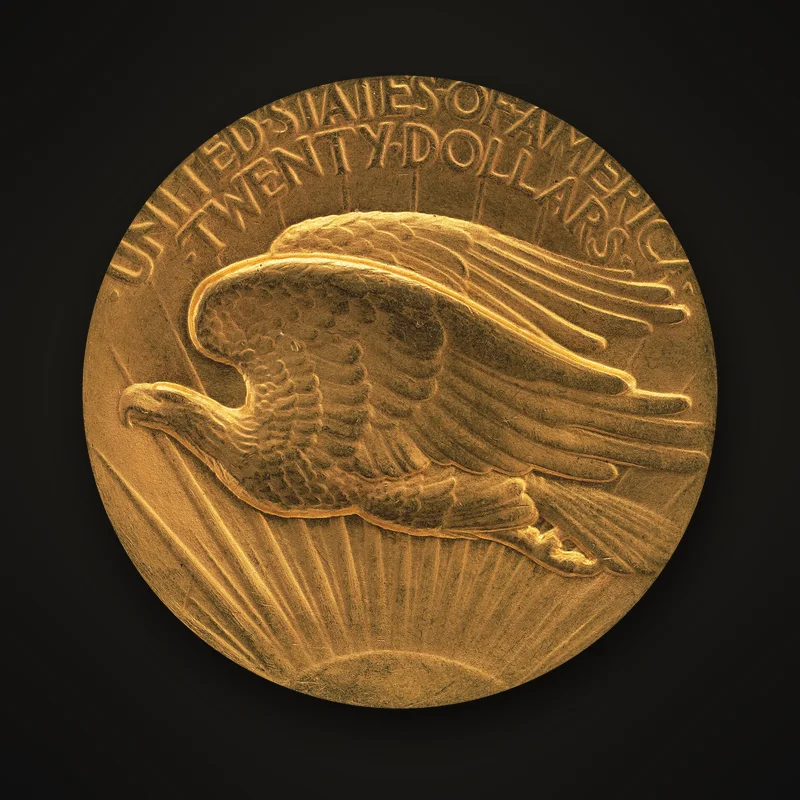
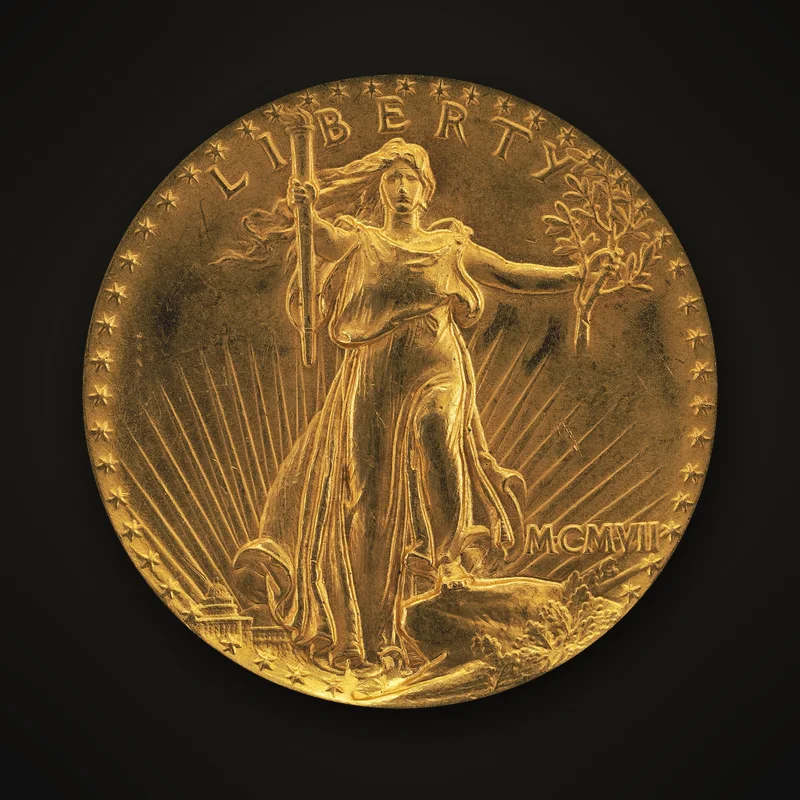
The Saint-Gaudens also comes in three stages. The first 1907 coins, in high relief, are dated MCMVII; several blows of the press were needed to bring up the design, hence their look of a small sculpture. Next come the lowered relief coins, dated in Arabic numerals and still without a motto. During 1908, an act of Congress had “IN GOD WE TRUST” added to the reverse. Finally, the admission of New Mexico and Arizona to the Union took the obverse from 46 to 48 stars in 1912: count them if the date is worn.
Period coin or imitation?
The double eagle is one of the most copied gold coins. Many fakes were produced in the 1960s and 1970s for gold buyers in the Middle East. These imitations often contain gold, and some even reach the official 33.44 g: scales alone therefore cannot settle the question.
Several signs should raise doubts: soft relief with rounded outlines; mushy engraver's initials or date numerals; a field dotted with small pits or tiny bumps; a lustre that is too bright, almost varnished; a gold colour unlike that of genuine coins. On rare dates, another fraud consists in engraving or erasing a mint mark on a genuine coin: the area around the letter then deserves a look under a loupe.
For a scarce date, a numismatist's opinion remains the safest way to reach a conclusion: see our coin valuation page.
Coins mistaken for a $20
The $10 gold eagle. It follows the same path (Liberty, then Indian head from 1907), but it weighs half as much and measures about 27 mm. Its reverse reads “TEN D.” or “TEN DOLLARS”.
Recent issues from the US Mint. In 2009, an ultra high relief Saint-Gaudens was struck in pure gold with the date MMIX: it is a modern collector coin. The American Gold Eagle, issued since 1986, reuses Saint-Gaudens's Liberty, but its reverse shows a family of eagles, and the ounce carries a $50 denomination.
Gilt reproductions. Sold as souvenirs, they copy both types, with or without the word “COPY”. Their weight stays well below 33.44 g.
Other large gold coins. The Mexican 50 pesos, heavier still with 37.5 g of fine gold, sometimes sits in the same box. The British sovereign, for its part, is much smaller.
Where to look for wear
On a Liberty, wear starts on the locks above the eye and the ear, then reaches the diadem, whose “LIBERTY” letters fade from the top. On the reverse, the eagle's head, neck and wing tops flatten first, until the feathers merge together.
On a Saint-Gaudens, check Liberty's breast and left knee, then her face and the torch. The tiny Capitol quickly loses its details. On the reverse, the feathers of the eagle's body and wing tell you how worn the coin is.
Many of these coins spent decades in bags of 250, deep in European bank vaults. They saw little use, but knocked against each other: small nicks in the field, knocks on the edge. For a collector, these marks often matter more than wear itself. Do not attempt any cleaning, whatever the temptation.
From the gold rush to European vaults
In 1849, Californian gold was pouring in and Congress decided to create a coin equal to two $10 eagles. James Longacre engraved its design, struck in volume from 1850. Philadelphia was not alone: San Francisco, New Orleans and Carson City, right next to the Nevada mines, also struck double eagles. From the 1880s, bags of 250 coins were shipped to Europe to settle trade balances.
In the early 20th century, Theodore Roosevelt, who found American coins unattractive, entrusted the design of the $20 to Augustus Saint-Gaudens. The sculptor died in August 1907 before finishing the work; Charles Barber then reduced the relief so that a single strike would do.
In 1933, Franklin Roosevelt first banned gold exports, then required private citizens to hand in their gold coins to the Treasury. The $20 coins dated 1933 were never distributed, and much of the recent output went to the melting pot. The coins lying in European banks escaped this melt and came back onto the market from the 1940s.